

Most of us look at paintings the way we glance at headlines. We register the subject, confirm a vague emotional tone, and move on. We consume the image as information, flattening it into a category—portrait, landscape, abstraction—before we have even let its surface touch our eyes. This is not seeing. This is optical scanning, a reflex trained by a culture that treats images as disposable data. To see a painting is to enter a different kind of time, a different politics of attention. It is to accept that the work is not a statement to be decoded but a physical presence that acts upon you, slowly, and often against your will.
The distinction matters because it is not merely aesthetic. It is a question of how we relate to the material world, to each other, and to power. When we look without seeing, we reproduce the logic of the spectacle: surfaces without depth, appearances without history, encounters without consequence. When we learn to see, we reclaim a space of resistance. This essay is an argument for that reclamation, written from the position of someone who has spent decades standing before canvases in museums, studios, and the forgotten corners of provincial galleries, learning to let them work on me.
The Anatomy of Looking
Looking is a predatory act. It seizes the object with the eye, names it, and discards it. The looker stands at a safe distance, protected by the presumption of mastery. In the museum, you can observe this every day: the visitor who walks up to a painting, reads the wall label first, glances at the image for three seconds, and moves to the next. The label has pre-digested the work, turning it into a fact. “Rembrandt, Self-Portrait, 1659.” The looker has consumed the fact and feels satisfied. There is no risk here, no vulnerability. The painting has been neutralized.
This habit is not innocent. It is the perceptual arm of a culture that insists on immediate utility. Everything must be knowable, classifiable, convertible into a takeaway. Looking at art becomes a form of extraction: we mine the image for its “meaning” and leave the residue behind. The residue, of course, is the painting itself—the paint, the weight of the linen, the specific tremor of the hand that laid down a brushstroke. All of this is sacrificed to the tyranny of the caption.
Consider the political implications. A society that trains its citizens to look without seeing is a society that prepares them to accept surfaces as truths. Advertising, propaganda, the choreographed sincerity of politicians—all of these rely on the glance, the quick hit of recognition that bypasses critical reflection. You think you’re just being lazy with a painting? You’re practicing submission. That billboard, that soundbite, that filtered photo—they all depend on you not looking twice.
What It Means to See
Seeing is a slower, more dangerous operation. It requires you to surrender the illusion of distance. To see a painting, you must allow it to happen to you, to let its physical reality press against your own. This means attending to what is actually there: not the story, not the artist’s biography, not the historical context—at least not at first—but the material fact of pigment on a surface. The way a particular gray was mixed, the direction of a brushstroke, the place where the canvas shows through. These are not technical details for connoisseurs. They are the primary language of the work, and learning to read them is a political education.

Seeing means acknowledging that a painting is an object before it is an image. It was made by someone in a specific body, under specific conditions. Those conditions leave traces. A brushstroke is not just a formal gesture; it is a record of pressure, speed, fatigue, intention. To see it is to enter into a relationship with another subjectivity, one that may be centuries dead but is suddenly, unnervingly present. This is why seeing can feel invasive, even violent. It breaks down the wall between subject and object. You are no longer a sovereign consumer of images. You are a participant in an encounter, and you might not like what you find.
I think of standing before a late Titian, where the paint is so thin and broken that the figure seems to be dissolving into the darkness. To look at that painting is to see an old man, a myth, a biblical scene. To see it is to feel the mortality in the paint itself, the way the hand trembled, the way the medium carries the knowledge of death. That knowledge is not intellectual. It is visceral, and it demands something from you. Maybe it demands you admit you’re also going to die. Most people don’t want to do that in a museum.
The Time of the Gaze
One of the clearest markers of the difference between looking and seeing is duration. Looking is fast; seeing is slow. There is a reason that museums exhaust us: we are doing the wrong kind of work. We are processing information, not attending to presence. The average time a visitor spends in front of a masterpiece is under thirty seconds. Thirty seconds is not enough time for a painting to even begin to reveal itself. It is not enough time for your own defenses to drop. Your brain is still chattering. The painting hasn’t even cleared its throat yet.
I have a practice that I recommend to anyone who wants to learn to see. Choose a single painting and stand before it for an hour. Do not check your phone. Do not read the label. Do not try to think smart thoughts. Just keep your eyes on the work. The first ten minutes will be agony. Your mind will scream for distraction. You will notice everything obvious, then you will think you have seen it all. Stay. After twenty minutes, something shifts. Details emerge that you could not have predicted: a tiny passage of red in a shadow, a pentimento where the artist changed his mind, a relationship between two shapes that suddenly reconfigures the whole composition. By the end of the hour, the painting has become a different object. You have become a different subject. You’ve sweated through your shirt, probably. That’s fine.
This kind of attention is a discipline, but it is not asceticism. It is pleasure, the deepest kind. It is also a refusal of the speed that capitalism demands. To spend an hour with a painting is to declare that your time is not a commodity, that your perception is not for sale. This is why slow looking is a radical act, however quiet it may seem. The guards will think you’re suspicious. Let them.
The Politics of Perception
I said earlier that I refuse to separate aesthetics from politics. This is not a slogan; it is a method. The way we are taught to see—or not to see—paintings is inseparable from the way we are taught to see people, landscapes, labor, suffering. A culture that reduces images to content is a culture that will reduce bodies to data. A culture that trains us to scan surfaces is a culture that will be shocked when we fail to recognize the humanity beneath the skin. And then it will blame us for being shocked, as if it hadn’t spent centuries teaching us to be shallow.
Consider the tradition of European portraiture. To look at a Gainsborough or a Reynolds is to see elegance, status, the performance of power. The painter’s technique is so polished that it becomes invisible; the paint does not call attention to itself. This is the aesthetics of aristocracy: the labor of making is hidden, and the image presents itself as natural, inevitable. To see such a painting is to notice the concealment, to ask whose work is erased, what violence is made to look graceful. The brushstroke that is not there is a political statement. It’s a lie by omission, and it’s been lying to you for three hundred years.
Or consider the opposite tradition: the visible brushwork of a painter like Soutine or de Kooning. Here the paint is aggressive, bodily, impossible to ignore. It refuses to become a transparent window onto a scene. It insists on its own materiality, and by doing so, it insists on the body of the painter, the labor of the act. This is not merely a stylistic choice. It is a claim about what counts as visible, what counts as real. To see such a painting is to confront the physicality of making, and by extension, the physicality of all those whose labor is usually rendered invisible. The janitor, the farmworker, the mother—their bodies are in the brushwork if you know how to look.
The Gaze and the Body
There is a gendered dimension to this as well. The traditional position of the viewer in Western art has been coded as male, possessive, controlling. The female body on the canvas is offered up to a look that demands pleasure and submission. To look at such an image is to accept that bargain, to take your place in a long line of anonymous voyeurs. To see it is to feel the violence of that arrangement, to locate the ways the paint itself may resist or complicate the narrative. In a painting by Artemisia Gentileschi, for example, the female body is not a passive surface. The brushwork is fierce, the compositions tense with danger. To see Gentileschi is to understand that the act of painting can be a counter-gaze, a refusal of the viewer’s assumed mastery. She’s not offering you anything. She’s holding a sword.
This is not historical trivia. The same dynamics play out every day in advertising, in film, in the endless scroll of images on our screens. Learning to see a painting is training for learning to see a culture. It sharpens your ability to detect what is being hidden, what is being naturalized, whose interests are being served by the way an image is constructed. You start to see the brushstrokes in a politician’s smile. It’s unnerving.
The Objecthood of the Painting
One of the most powerful things a painting can do is remind you that it is a thing. In an age of digital reproduction, where every artwork is reduced to a JPEG, the physical object becomes a site of resistance. A painting has weight, texture, scale. It changes under different light. It ages. It carries the marks of its own history: craquelure, darkened varnish, the scars of restoration. All of this is part of the work, and all of it is lost when we look at it as a mere image. You can’t smell a JPEG. You can’t see the dust on the frame.
I think of a panel by van Eyck, small enough to hold in your hands, painted with a precision that seems to deny the existence of the brush. To look at it is to marvel at the illusion. To see it is to reckon with the impossible patience of the maker, the tiny sable hairs that left their microscopic traces, the oil that yellowed over centuries. The object is a repository of time, and time is precisely what the digital image strips away. When you stand before the physical painting, you are in the presence of something that has survived. That survival is not a metaphor. It is a fact with political weight. This thing outlived wars, revolutions, and everyone who ever loved it.
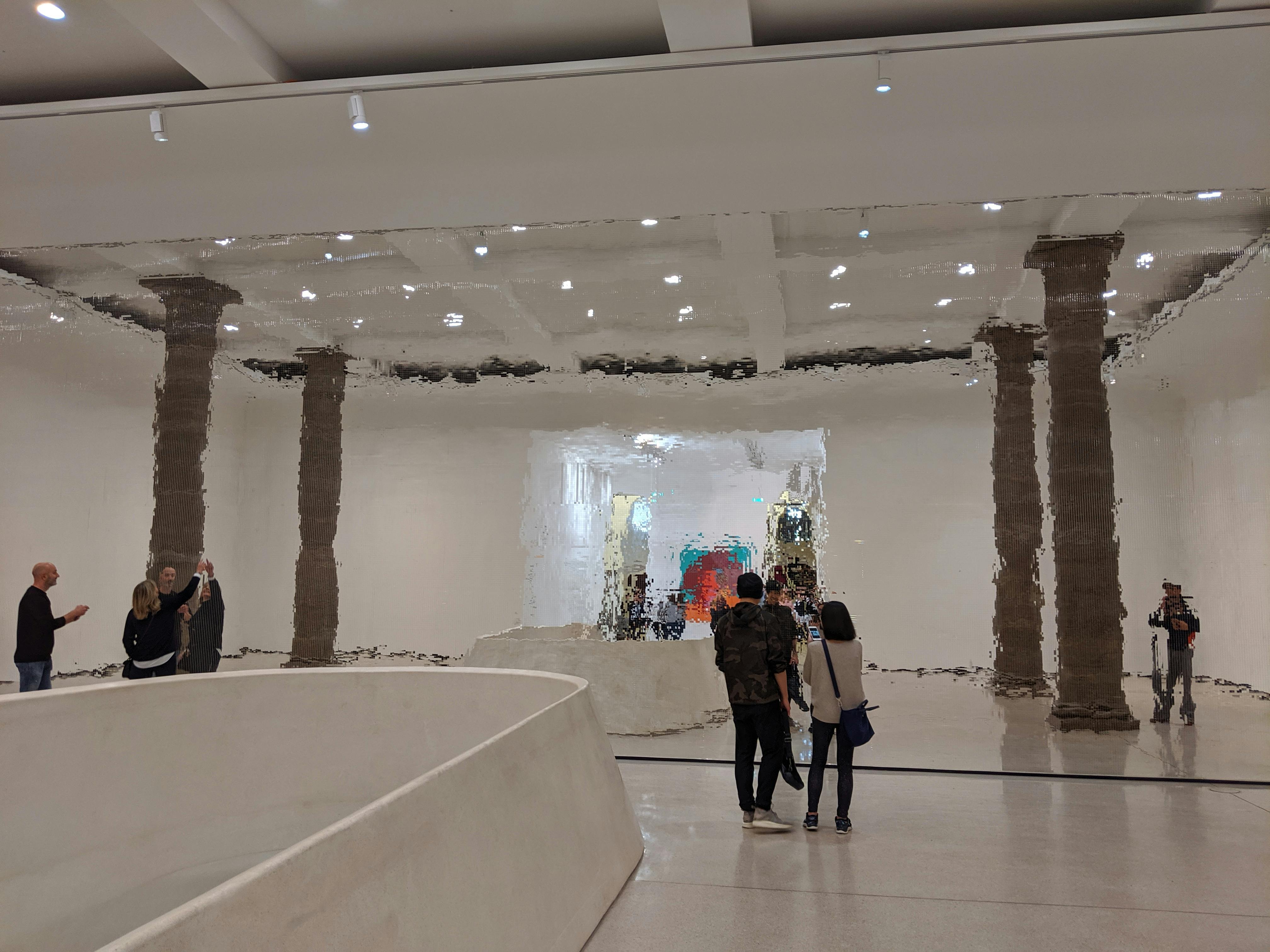
This is why museums are not neutral spaces, despite their best efforts to appear so. They are theaters of power, where certain objects are preserved and others are not, where certain histories are told and others are silenced. To see a painting in a museum is also to see the museum: the architecture, the lighting, the arrangement of rooms, the presence of guards. All of this frames your encounter. Learning to see means learning to see the frame. And sometimes the frame is a gilded cage.
Practice and Discipline
I am often asked how one learns to see, as if it were a trick or a secret. There is no secret. There is only practice, and the willingness to be uncomfortable. Here are some concrete steps, drawn from my own experience and from the wisdom of painters and teachers I have known. They are not magic. They are work.
First, go to a museum or a gallery when it is not crowded. Weekday mornings are best. The presence of crowds makes slow attention nearly impossible. You need quiet, not because painting is a refined pleasure, but because seeing requires a lowering of your own defenses, and you cannot lower them in a crowd. You’ll be performing for the people around you. Stop it.
Second, choose one painting and stay with it. I have already mentioned the hour-long exercise. If that is too much, start with twenty minutes. The point is to break the habit of the glance. Let your eyes roam over the surface without trying to summarize. Notice what you notice. There is no correct thing to see. The goal is not art-historical knowledge; it is perceptual awakening. You might be bored. Good. Boredom is a doorway.
Third, describe the painting to yourself in words, silently or aloud. Use precise language. Instead of “a blue sky,” say “a pale gray-blue, thinly painted, with streaks of warmer white near the horizon.” This forces you to look more closely and to translate visual experience into another register, which can reveal what you have missed. It also makes you sound like a lunatic muttering in a gallery. Embrace it.
Fourth, learn something about how paintings are made. Take a basic painting class, or watch a conservator at work, or read about historical techniques. Understanding the material process demystifies the object while deepening your respect for it. You will never see a glaze or an impasto the same way again. You’ll know what it cost to make that mark. You’ll know the mess.
Finally, accept that some paintings will remain opaque to you. Not every work will open itself. Some are closed, or damaged, or simply not meant for you. This is fine. The posture of mastery is the enemy of seeing. Humility before the object is a prerequisite. You are not entitled to understanding. Stand there and take the silence.
The Ethical Dimension
I want to be clear about what is at stake. This is not a self-help essay about how to enjoy art more. It is an argument about how to live. The capacity to see a painting is continuous with the capacity to see a person, a landscape, a political situation. It is a training in attention, and attention is the ground of ethical life. When we look at the world without seeing it, we become capable of horrors. The history of the twentieth century is a history of people who looked and did not see. They saw categories, stereotypes, threats. They didn’t see the face.
Paintings, at their best, are instruments for recalibrating our perception. They slow us down. They make us confront the fact that reality is not a given but a construction, made by hands and minds with interests and blind spots. To see a painting is to practice the kind of attention that can, if we let it, spill over into the rest of our lives. It is to insist that surfaces are not enough, that the world deserves more than a glance. It deserves your exhaustion, your confusion, your time.
This is why I continue to stand before canvases, even after all these years. Not for pleasure, though pleasure is there. Not for knowledge, though knowledge accumulates. I do it because it is a discipline of resistance. Every hour I spend with a painting is an hour I have refused to give to the machinery of distraction. Every brushstroke I trace with my eyes is a reminder that labor leaves traces, that history is embedded in matter, that the past is not past. To see is to remember. To look is to forget. The choice is ours, moment by moment, in every gallery, in every room.
Frequently Asked Questions
What is the main difference between looking and seeing a painting?
Looking is a quick, surface-level act of identifying an image and moving on, often driven by habit and the desire for instant understanding. Seeing is a slower, more engaged encounter that involves attending to the material qualities of the work—its brushstrokes, texture, and physical presence—and allowing it to affect you emotionally and intellectually over time. Seeing requires vulnerability and a willingness to let the painting act upon you, rather than simply consuming it as information.
How can I practice seeing rather than just looking?
Start by choosing a single painting and spending at least twenty minutes with it, resisting the urge to check your phone or read the label. Let your eyes move slowly across the surface, noticing details like color variations, paint thickness, and subtle shifts in composition. Describe what you see to yourself using precise language. Over time, this practice will deepen your perceptual awareness and break the habit of the quick glance.
Why does the distinction between looking and seeing have political implications?
The way we look at paintings reflects and reinforces broader cultural habits of perception. A society that trains us to consume images quickly, without critical attention, also prepares us to accept surfaces as truths in advertising, politics, and media. Learning to see a painting—its materiality, its hidden labor, the power dynamics it may encode—sharpens our ability to question the images and narratives we encounter in daily life, making it a form of ethical and political resistance.
Do I need to know art history to truly see a painting?
No. While historical context can enrich your understanding, seeing begins with direct sensory engagement. The physical facts of the painting—its scale, texture, and the way it is made—are accessible without specialized knowledge. In fact, relying too heavily on art history can sometimes turn a painting into a mere illustration of a textbook fact, bypassing the immediate, visceral encounter that is the foundation of seeing.