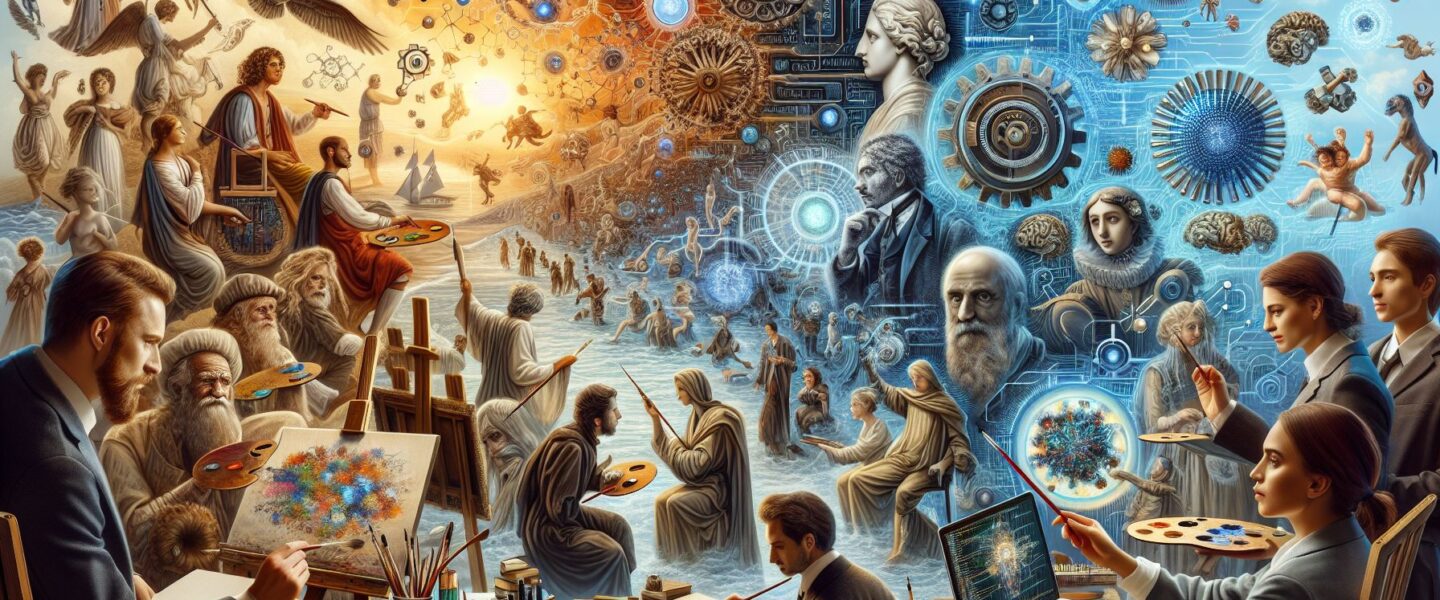
Hey there, fellow tech enthusiasts! Today, I want to explore a really fascinating corner of the tech universe that’s been capturing my imagination lately—AI in creative arts. That’s right, artificial intelligence is not just for crunching numbers, automating tasks, or piloting drones. It’s also stepping boldly into the world of creativity, where it’s mixing oils on a digital canvas or composing symphonies of code. And frankly, it’s making quite the splash!
A Brush with Code: How AI is Painting the Future
Let’s start with one of the most visually interesting intersections of AI and art—painting. Back in the day, if you wanted to create a masterpiece, you’d probably reach for a canvas and some brushes. These days, artists are collaborating with neural networks to create digital paintings that burst with creativity and, dare I say, originality.
Remember that moment when GANs (Generative Adversarial Networks) shocked the world by creating art pieces that sold for hundreds of thousands at auction? That wasn’t a fluke. It’s quickly becoming the norm. These networks learn a huge array of styles and strokes, drawing from the vast repository of historical art to produce something genuinely new. They’re kind of like art historians with a flair for avant-garde expression, but faster and sometimes weirder.
This new partnership between artists and algorithms is opening up fresh opportunities for creativity. Instead of replacing human artists, AI is helping them do more, allowing them to experiment with styles previously considered impossible or impractical. It’s like giving your favorite artist a set of superpowers and watching them fly!
A Symphony of Algorithms: The Music of the Machines
Alright, who here plays an instrument? I’ve noodled around with a guitar for years, and let me tell you, when AI enters the scene, it’s like opening Pandora’s music box of infinite possibilities.
Music composition is another area where AI is making serious waves. Ever heard of AIVA (Artificial Intelligence Virtual Artist)? It’s an AI composer that can whip up everything from dramatic film scores to soothing piano pieces. The best part? You’d be hard-pressed to tell it apart from a human composer. These algorithms analyze millions of Beethoven and Mozart pieces, learn their complex patterns, and then generate brand-new compositions. It’s like having a digital Beethoven just waiting to drop a surprise album.
Musicians are now collaborating with AI to discover uncharted sonic territories, pushing the boundaries of what humans and machines can create together. The result is a music scene that’s part traditional, part experimental, and wholly exciting. We’re talking about computational creativity at its finest, something that challenges our ideas about music.
Lights, Camera, Bot! AI and the Silver Screen
And what about the movies and TV shows we binge-watch? The screen is yet another canvas where AI artists are working their magic, changing not just how stories are told but who—or what—is telling them.
From AI-generated screenplays to computer-generated characters, artificial intelligence has become an essential tool for filmmakers. Remember that time when a short horror film called “Sunspring,” written entirely by AI, made some waves online? It turned out quite… interestingly. Though the plot was as chaotic as a cat’s dream, the experiment showed the strange potential of machine-crafted narratives.
AI is also changing the way special effects are created, with machine learning algorithms speeding up processes that once took weeks of careful labor. Imagine cutting the time needed to create fantastical CGI landscapes or realistic animated creatures in half. That’s happening right now, and it’s one of those behind-the-scenes revolutions that’s quietly transforming the industry.
The Great Creativity Debate: Man vs. Machine vs. Hybrid
While all this sounds like the beginnings of a techno-utopia, it’s also sparked debates about what it means to be creative. Can machines genuinely create art, or are they just recycling data in aesthetically pleasing ways? Personally, I think the truth lies somewhere in between.
Humans have unique emotional depths and cultural insights that no machine can copy—at least not yet. However, AI can process vast amounts of information and spot patterns and connections that a human might miss. The magic really happens when you combine these strengths, creating the perfect storm of creativity where humans and machines inspire each other.
The Path Ahead: Deciphering the Artistic Code
So, what’s next on this exciting journey at the crossroads of art and technology? For one, we’re likely to see AI play an even larger role in democratizing art, making it easier for more people to express themselves creatively. Imagine an app that lets anyone generate a full symphony or a painting in the style of their favorite artist in minutes.
As AI continues to evolve, we’ll probably see more personalized and immersive experiences that cater to individual tastes and moods. Think about virtual reality environments that change in response to your emotional state, or personalized soundtracks that capture the essence of your day.
As wild as it might sound, the next few years promise to be a rollercoaster of innovation and exploration, driven by the extraordinary potential of AI in the arts.
Final Thoughts: The Unfinished Canvas
AI in creative arts isn’t just a passing fad. It’s a renaissance in the making. The relationship between human and machine creativity is still in its infancy, teasing us with glimpses of what could be. And while there might be bumps in the road—legal challenges, ethical questions, and technology hiccups—the horizon looks pretty amazing.
As someone with a deep appreciation for both art and tech, I’m thrilled to be witnessing this fusion firsthand. It’s an exciting era, folks. A time when the canvas is large, the colors infinite, and the only limit is our imagination… plus a few lines of code.
Thanks for sticking with me through this digital voyage. Until next time, keep creating, stay curious, and never stop exploring the art of the possible!