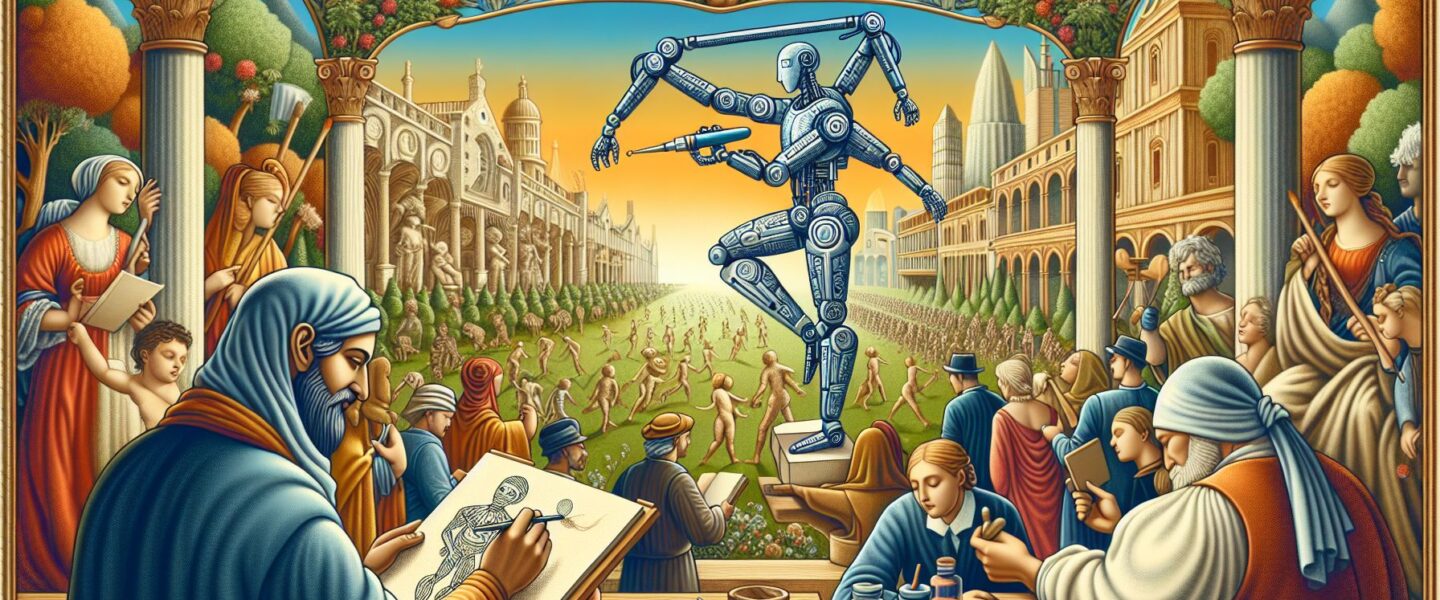
Hey there! I hope you’re as psyched as I am about what’s happening in the world of technology, specifically in the intersection of art and artificial intelligence. It feels like we’re standing at the forefront of a digital renaissance, a techno-utopia where creativity and machines synergize. Imagine a world where AI isn’t just a tool, but a collaborator in the creative process. Let’s dive into this fascinating world of AI in the creative arts, and I promise, it’s going to be more colorful than a Van Gogh.
AI: The New Artist in the Room
Alright, let’s start at the beginning. How did we even get here? Once upon a time, a bunch of brilliant computer scientists thought, “Hey, maybe these computer thingamajigs could create beautiful art too!” Fast-forward a few years, and now artificial intelligence is producing art so mesmerizing that it puts some human-created works to shame. Remember DeepDream from Google? That was like our first peek into the AI art rabbit hole.
What’s fascinating is that AI doesn’t just imitate human creativity; it encourages it. Take the example of OpenAI’s DALL-E. This neural network was trained to generate images from textual descriptions. Input something wild like “a two-headed flamingo wearing roller skates,” and voilà, out comes an image you’ve never imagined in your wildest dreams. It’s like having an imaginative child, but this one won’t draw on your walls.
Bridging Tradition and Innovation
An interesting angle to this whole AI art phenomenon is how it marries tradition with modern technology. Remember when art used to be about paintbrushes and canvases? Well, meet AI brushstrokes. These algorithms analyze countless works from history’s greatest artists and blend styles in ways never thought possible.
Quirky fact—the British auction house Christie’s sold an AI-generated artwork for a whopping $432,500! Created by the collective Obvious, “Portrait of Edmond de Belamy” isn’t just a piece of art, but proof of how AI can add value to the traditional art market. Cue the skeptics: “Is it real art if a machine makes it?” I say, why not? As long as it evokes emotion and makes us think, isn’t that the point of art?
Music in the Mechanical Era
Shifting gears from visual arts to music, AI’s hitting all the right notes, literally. Musicians today are collaborating with AI to compose symphonies, create beats, and even transform the music production landscape. A musician friend of mine recently introduced me to Jukedeck, an AI tool that generates royalty-free music. He needed background music for a video, and this AI whipped up a catchy tune in a matter of minutes. Talk about saving studio time!
Elon Musk’s OpenAI also made waves with MuseNet, an AI capable of composing music in styles ranging from Mozart to the Beatles. Now, let’s get philosophical for a sec: Is it still “human” music when machines create it? Well, I think it’s opening doors to new genres, and who doesn’t love a new beat?
Challenges and Ethical Quandaries
Of course, it’s not all sunshine and rainbows; there are some serious questions lurking around the corner. The ethical considerations with AI-created art are vast. What happens to credit and ownership? If Monet were alive today and saw machines mimicking his style, he’d probably throw his beret to the ground.
A case in point is the issue of copyright. Who owns AI-generated art? The creator of the algorithm? The user? The machine itself? In some regions, the law is still catching up much like an underdog in a tech race. But it does make for heated conversations over coffee when you’re hanging out with lawyer friends.
The Future: Collaboration, Not Competition
Now, what does the future hold? Should artists be worried about being replaced? I’d say, no. If anything, artists should embrace the potential of AI. Imagine a world where artists have AI as their trusty sidekick, much like Batman has Robin. The collaboration could enhance creativity, speed up production, and open up new realms of aesthetics and experimentation.
My personal take? If we lean into this blend of technology and creativity with an open mind, we could be heading for a new era of art that rivals the Renaissance.
Conclusion: Embracing the Machine Muses
So, fellow tech enthusiasts, as we tread deeper into this melded universe of AI and the creative arts, let’s remember that innovation happens when imagination meets intelligence, both human and artificial. Why not let AI be our muse and partner in creativity?
Who knows? Maybe the next Mona Lisa will smile out at us from a digital canvas infused with AI-driven ingenuity. So, go on, fire up your imagination engines, because the future of art is as captivating as it is unpredictable. Cheers to the machines!
And, oh, if you stumble upon a two-headed flamingo on roller skates, just remember, there’s probably an AI behind it with a mischievous grin.