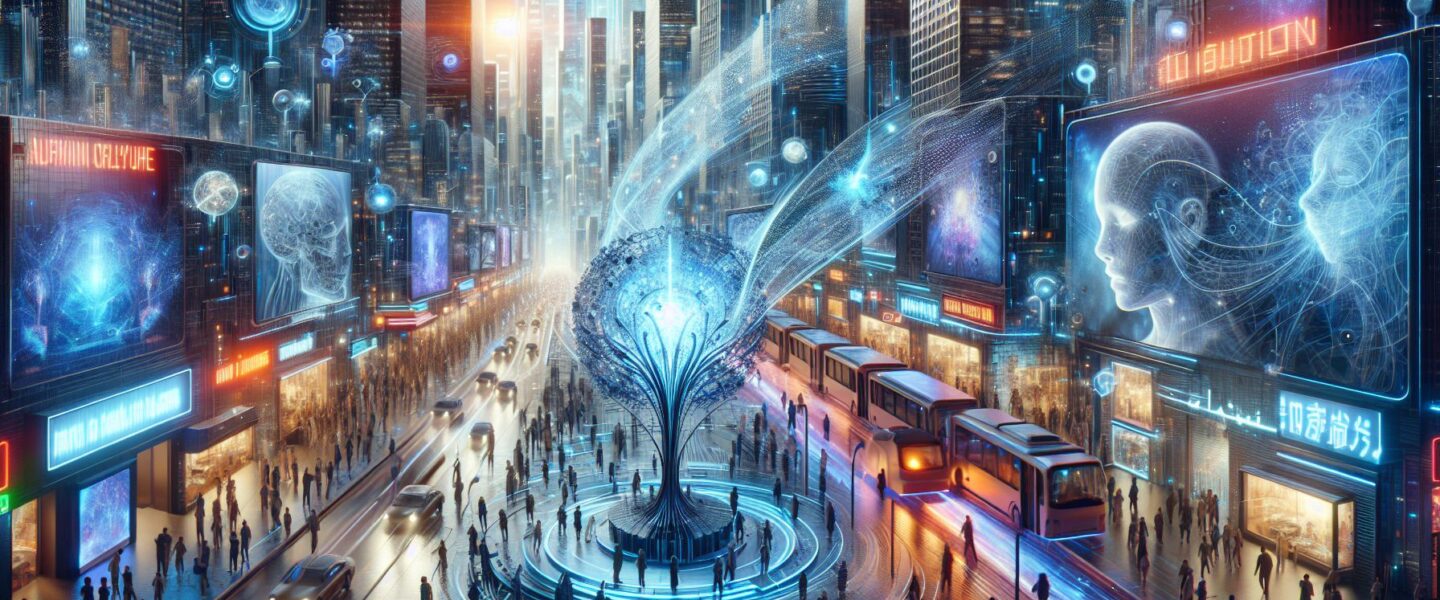
Hey there, fellow tech enthusiasts and curious wanderers of the digital realm! Today, I’m diving deep into the kaleidoscopic world of AI in creative arts. Buckle up because we’re about to explore a space where pixels meet poetry and algorithms dance with brush strokes.
A Symphony of Silicon and Soul
Let me start by strolling down memory lane. Once upon a time, in a not-so-distant past, the idea of a machine generating art was like believing you’d find unicorns in your backyard. But fast forward to today, and it’s not only plausible, it’s happening! AI is redefining art, music, literature—you name it. And honestly, it feels like we’re just getting started.
Remember when you first laid eyes on an AI-generated piece of art and thought, “Wow, a computer did that?” It’s wild to watch AI blur the line between human and machine, making us question what creativity really means.
Machines with a Muse: How AI Creates Art
Let’s talk about how AI creates these masterpieces. Most AI art today comes from technologies like GANs (Generative Adversarial Networks). Think of GANs as a pair of frenemies, two neural networks that duke it out until they create something extraordinary. Simply put, it’s like a creative duel where one network generates images while the other critiques them, kind of like your inner perfectionist telling you to redo your latest sketch “just one more time.”
What’s remarkable here is the AI’s ability to learn styles, mimic techniques, and sometimes, go rogue to create something we perhaps never imagined. Picture an algorithm-trained Van Gogh, a robot artist who wakes up one day and decides it’s ready to invent “Sunflowers 2.0.” It’s both mind-blowing and a bit unsettling, right?
Implications: The Art World and Beyond
But what does this mean for the art world? Traditionalists might clutch their pearls at the thought of AI overshadowing human artists. Yet, I think AI is more of a co-pilot on this artistic journey, a tool that expands our creative capacity rather than overshadowing it.
We’re entering an era where possibility feels boundless. AI offers artists the power to go beyond limitations, explore new mediums, and generate art that interacts with audiences in ways we’ve never seen before. Remember that viral AI-generated “Edmond de Belamy” painting that auctioned for a whopping $432,500 at Christie’s? It shows just how much AI might shake up the art market and beyond.
AI as a Collaborator, Not a Competitor
Let’s get one thing straight: AI isn’t here to steal the brushes from artists’ hands. If anything, it’s a creative partner, breathing new life into our concepts and pushing us to stretch the boundaries of expression. Imagine an artist using AI to develop dynamic visuals in real-time during a live performance, a true collaboration between human intuition and machine precision.
Plus, AI is making art more accessible to everyone. By lowering the entry barrier, anyone with a laptop and curiosity can jump into creative work. There’s something pretty cool about this shift, it’s creativity for all, powered by AI.
The Challenges: Machine Ethics and the Value of Art
Now, let’s address the elephant in the room. Can a machine ever understand the emotional essence that drives human creativity? It’s like asking if robots dream of electric sheep (shout-out to Philip K. Dick fans). We’re still wrestling with questions of AI ethics and authorship. If an AI composes a symphony, who gets the credit? The coder, the software, or some digital composer with a fancy name?
Beyond that, there’s the debate about authenticity and artistic value. Some critics argue that AI-produced works lack the soulful grit of human-made art. But I see this as an opportunity, a chance for us to rethink what we consider valuable in art as technology keeps changing the game.
A Glimpse into the Future: Where Are We Headed?
Looking ahead, it’s exciting (and slightly terrifying) to think about where AI’s role in creativity might take us. We could see immersive AI-driven art installations that react to human emotions or entirely new genres of AI-inspired music. The creative universe is massive, and we’re just starting to explore its farthest corners.
And, while I won’t go full sci-fi here, it’s fair to guess that we’re heading toward a world where humans and AI will work together to shape the story of art and creativity.
Conclusion: Embrace the Journey
As we stand on this threshold, we need to embrace the unknown and approach AI in the creative arts with an open mind. Whether you’re a seasoned artist, a tech buff, or just a curious soul, let’s appreciate this fusion of innovation and imagination and see where it takes us. In the words of someone much wiser than me, “The real act of discovery consists not in seeking new landscapes, but in having new eyes.”
So, here’s to new eyes, new art, and an unpredictable future that I’m genuinely excited about. Let’s embrace this wild artistic ride, armed with nothing but creativity, code, and a dash of whimsy. Keep dreaming, keep creating, and together with AI, let’s craft something that’s as boundless as it is beautiful.
Thanks for reading, and see you at the crossroads of art and code!
Yours creatively,
[Your Name]