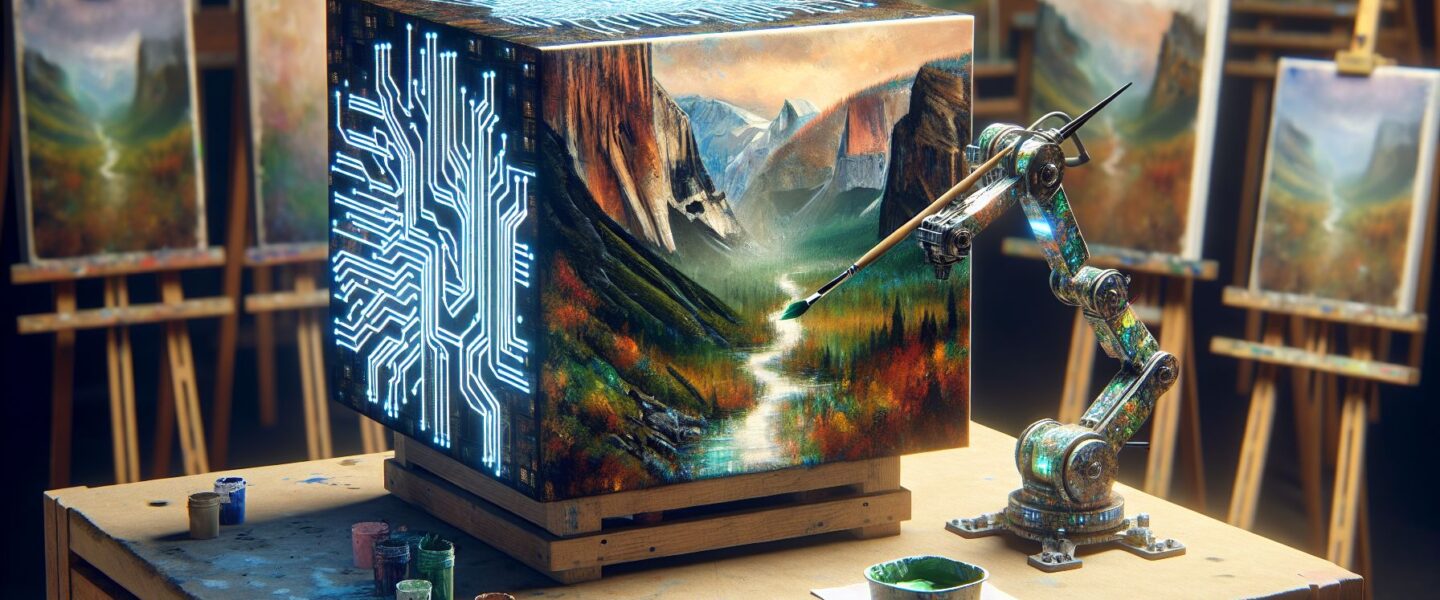
Hey there, fellow tech enthusiasts! Grab your favorite mug—I’ve got mine filled with some questionable coffee mix—and let’s talk about AI stepping out of the coding shadows and onto the creative stage. Today, I’m going to discuss how AI is changing creative arts in ways I never saw coming. Spoiler alert: Van Gogh might be turning in his grave with excitement!
The Brush Strokes of Algorithms
Let’s kick things off with a confession: I’ve always been an art skeptic. Don’t get me wrong, I can appreciate a good Monet or Da Vinci as much as anyone namedrop-loving culture vulture, but when it came to tech and art mingling? I was skeptical—until AI started to prove me otherwise.
AI-powered tools have crawled out of obscure labs and onto our phones. Platforms like DeepArt and Google’s DeepDream have been around for a while, turning anyone with a smartphone into a digital artist. I tried DeepDream with an old cat pic, and whoa—I ended up with something that looked like my cat tripped into an alternate fractal universe. But here’s where it gets interesting: AI is moving beyond fancy filters. It’s creating entirely new art pieces that make us rethink what creativity actually means.
Algorithms That Learn to Create
One of the most exciting developments here is Generative Adversarial Networks, or GANs. Invented by researcher Ian Goodfellow (a name cooler than most sci-fi protagonists), GANs pit two neural networks against each other: one generates images, the other judges them. The result? AI art that’s evolved from baby doodles to prize-winning masterpieces.
I’ve seen AI-generated artwork so evocative and thought-provoking, it’s hard not to question where the line between human and machine creativity actually lies. There’s a piece called “Edmond de Belamy,” created by a Paris-based collective using a GAN, which sold for $432,500 at auction! While my digital cat dreamscapes still go unnoticed, this sale changed how we think about ownership and creativity in art.
AI’s Star Role in Music
Once you’re done being impressed by AI’s visual art exploits, sit down because it’s also making waves in music. Ever hear a track so catchy you play it on repeat until it becomes the soundtrack to your life? Well, don’t be surprised if you soon fall for a tune created by an AI composer who’s more about bits and bytes than guitars and bass.
OpenAI’s MuseNet is a standout here—a neural network that can generate 4-minute musical compositions with 10 different instruments. It pulls inspiration from everywhere, even genres I didn’t know existed. The results aren’t half-bad. It’s like having Mozart and The Beatles collaborate with EDM thrown into the mix. Weirdly satisfying!
Redefining Collaboration
It’s not just machines working solo. AI is making collaboration possible between musicians who’ve never met. Picture an indie artist in Tokyo creating a soundscape with someone in Berlin without saying a word to each other, connected through AI music production platforms. There’s something democratizing about this creative shift—it breaks down barriers, bringing art to more people in more places than ever before.
More Questions Than Canvas Space
Of course, no tech conversation is complete without some tough questions. Is AI actually being creative, or is it just sophisticated mimicry? What does this mean for human artists and musicians? And who owns the rights to artwork created by lines of code?
These questions are keeping today’s visionaries and stakeholders busy. Museums and galleries are wrestling with AI art exhibits. Music labels are figuring out what it means for AI to get composer credits. Meanwhile, intellectual property experts are having sleepless nights over digital rights management. We’re just at the beginning of a conversation that spans legal, ethical, and creative territory.
Tomorrow’s Canvas
Looking ahead, the possibilities are mind-boggling. AI’s relationship with creative arts could unlock art forms and experiences we haven’t imagined yet. Maybe our leisure time will include not just creating art but collaborating with AI, mixing human intuition with silicon precision.
As this develops, I keep thinking that AI isn’t replacing human creativity—it’s amplifying it. Imagine artists who aren’t held back by technique or medium limitations but empowered by a partner that can bring their wildest visions to life. If that doesn’t paint an exciting picture, I don’t know what does!
So here we are, caught between pixels and paint, bleeps and beats. Whether you’re an art skeptic or an aficionado, there’s no denying AI has picked up the brush and joined the creative process with energy that’s impossible to ignore. And for better or worse, we’re all along for this beautifully unpredictable ride. Cheers to unpredictability—my coffee sure is!