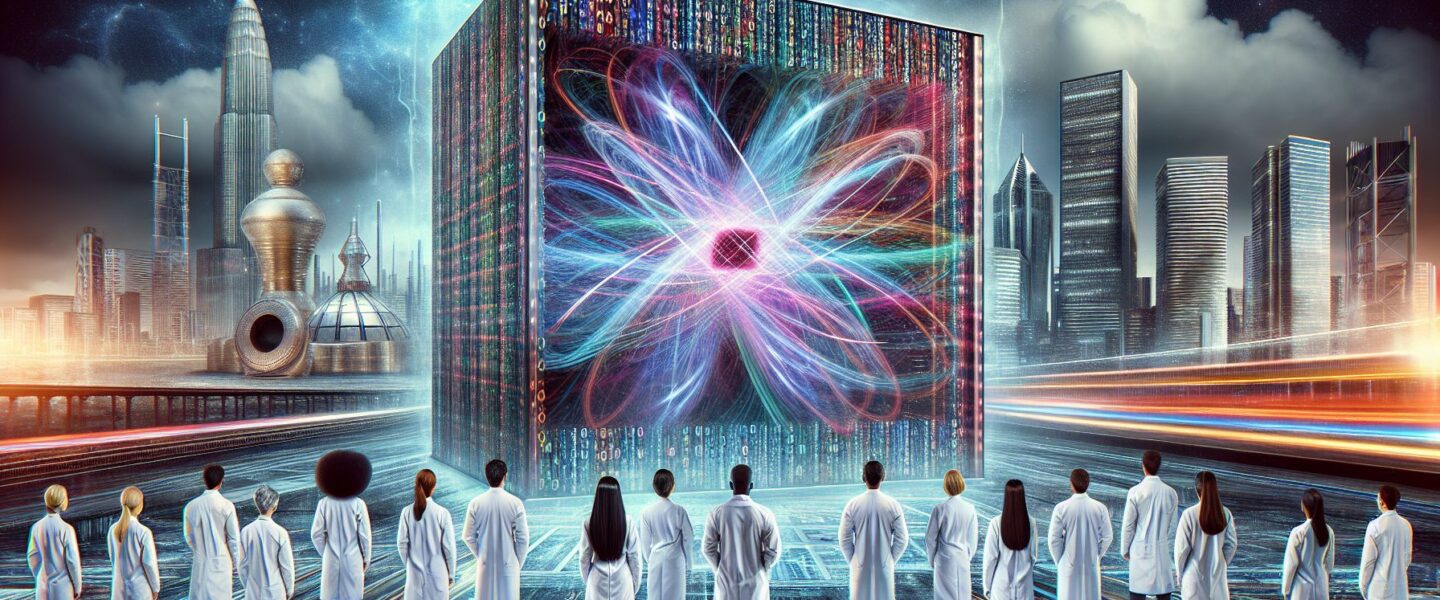
Hey there, my fellow tech enthusiasts! Today, I’m bubbling over with excitement to dive into the mysterious and mind-bending world of quantum computing. Imagine a computer that can solve complex problems in seconds, problems that would take today’s supercomputers eons. Sounds like something out of a sci-fi novel, right? Well, buckle up because quantum computing might just be the leap into the future we’ve all been waiting for.
What Exactly is Quantum Computing?
Alright, let’s break this down without dredging up your old physics textbooks. In simple terms, quantum computing uses the bizarre properties of quantum mechanics, which governs the subatomic world. Unlike classical computers that use bits (0s and 1s) to process data, quantum computers use quantum bits, or qubits.
Here’s the kicker: qubits can exist in multiple states at once, thanks to a phenomenon called superposition. Now, add another layer of weirdness known as entanglement, where the state of one qubit is directly linked to another, no matter the distance. This allows quantum computers to process massive amounts of data simultaneously. In geek speak, their computational power grows exponentially with the addition of each qubit. Mind-blown yet?
Real-Life Applications
Now that we’ve cracked open the quantum egg, let’s look at how this technology is set to transform various fields. Spoiler alert: the implications are colossal.
Medical Marvels
Picture this: a world where we can simulate molecular interactions at unprecedented scales. This means designing new drugs and treatments for diseases in mere days instead of years. Quantum computers can model complex biological systems, opening doors to curing diseases that were previously a medical mystery.
Cryptography and Cybersecurity
Say goodbye to traditional encryption methods! Quantum computers have the potential to crack classical cryptography like an eggshell. But don’t panic, quantum encryption is on its way to create the most secure communications we’ve ever known. We’re talking bulletproof.
Environmental Impact
Need to tackle climate change? Quantum computing could aid in designing environmentally friendly materials, optimizing renewables, and even solving complex climate models. Imagine creating more efficient solar panels or perfecting carbon capture technologies. The possibilities for a cleaner planet are endless.
Challenges on the Quantum Frontier
Of course, like all revolutionary technologies, quantum computing isn’t without its hurdles. Let’s chuckle through a few of these challenges.
Error Rates and Stability
Quantum computers are notoriously finicky. Their qubits are super sensitive to environmental changes, leading to potential errors. It’s like trying to hold a meeting at a rock concert. Scientists are working hard to improve qubit stability and error correction, but there’s still a journey ahead.
Decoherence: The Party Pooper
Remember that fun term “superposition”? Well, decoherence is its arch-nemesis. It’s when a qubit loses its quantum state because of outside interactions. Think of it as the grumpy neighbor crashing your weekend party. Researchers are developing techniques to keep these party crashers at bay, but we’ve got some work to do.
The Cost of Quantum
Building quantum computers isn’t cheap, folks. With the technology still in its infancy, costs are astronomical. We’re talking chic high-rise prices to keep these chilly machines running close to absolute zero temperature. But as the tech matures, we can expect these costs to lower, making quantum computing more accessible.
What’s Next: The Future Outlook
So, where does this leave us? While we’re not quite at the point of everyone having their own quantum laptop, the pace of advancements is skyrocketing. Notable companies like IBM, Google, and D-Wave, along with budding startups, are racing to develop scalable and practical quantum computers. It’s like witnessing a Formula 1 race of computational breakthroughs!
Speculating Tomorrow’s Quantum Wonders
Peering into my crystal ball, I speculate that within a few decades, quantum computing will integrate into various industries, optimizing everything from logistics to AI. Imagine AIs capable of creative arts, expressing human-like creativity, or predicting natural phenomena with jaw-dropping accuracy.
Conclusion: A Brave New Quantum World
In our quest for ever-faster processing and new discoveries, quantum computing represents a major shift in technological history. It’s the genie that might just reshape modern life, solving problems on scales we can only dream of today.
Until that day comes, let’s continue eagerly rooting for our tech pioneers, working tirelessly to bring us quantum magic. Whether in the lab or in the headlines, the quantum revolution is just beginning, and it’s bound to be a thrilling ride.
Stay curious, and maybe, keep a few pairs of quantum goggles handy. We’re all in for some serious technicolor spectacles!